 PO Box 930 Revesby New South Wales (NSW) 2213
PO Box 930 Revesby New South Wales (NSW) 2213
PO Box 930 Revesby New South Wales (NSW) 2213
PO Box 930 Revesby New South Wales (NSW) 2213
PO Box 930 Revesby New South Wales (NSW) 2213

Best Price Guaranteed

Free Quotes

On-Time Completion

No Hidden Fees
Two things usually have to be settled before a demolition quote means anything: which council assesses the job, and whether the postcode is hiding a boundary. A demolition in Ermington, postcode 2115, has both answered before anybody looks. City of Parramatta Council is the consent authority for every address in the suburb, and Super Demolition works here holding a current Demolition Licence and a current Asbestos Removal Licence.
The boundary data puts the whole of Ermington inside City of Parramatta. There is no street where that flips and no second register to check, which several suburbs nearby cannot say.
The instrument over your lot is the Parramatta Local Environmental Plan 2023, which replaced the 2011 plan. Anything still quoting the older one is out of date.
The same crews cover demolition in Rydalmere, demolition in Dundas and demolition in Dundas Valley, all in the same council area, and we work across Western Sydney under the same two licences.

Super Demolition is a family business, owned and managed by Jack, who walks the block with you before anything is priced. There are over 30 years of experience behind it. Customers have left a 5.0 rating from 84 reviews.
Two licences carry the work: a current Demolition Licence and a current Asbestos Removal Licence. Our staff and contractors comply with WorkCover requirements to Australian Standard 2601-2001, and your Work Method Statement is written against it. Fuller credentials sit with our residential demolition service.
Those are worth checking, on us or on anybody else. A licence number can be verified. A suburb name printed above a phone number cannot.
The site assessment and the written quote are free, and every enquiry gets an answer within 24 hours. Call 0455 888 819.
NSW gives you two routes. A Complying Development Certificate is issued by a private certifier against fixed standards written into a code: the land and the proposal either meet them or they do not. A Development Application goes to City of Parramatta Council, which weighs the job on its merits against the controls for the site.
Most of it here goes the first way. The council’s public lodgement feed returned 556 applications across the two months to the start of August 2026. Of those, 155 carried demolition wording. Among the demolition records that ran as a certificate or an application, 84 were certificates and 41 went to council. That is 67.2% on the certifier route. That feed carries recent lodgements, not a full history, so it describes that window only.
What decides your route is the land and the scope, never a preference. A plain knockdown on an unconstrained lot usually fits the code. Bolt a subdivision, a second dwelling or a change of use onto it and it is judged on merit instead, and so is a lot the mapping constrains: a heritage listing, a conservation area or contamination closes the certificate route. We read the mapping over your title before anything is lodged.
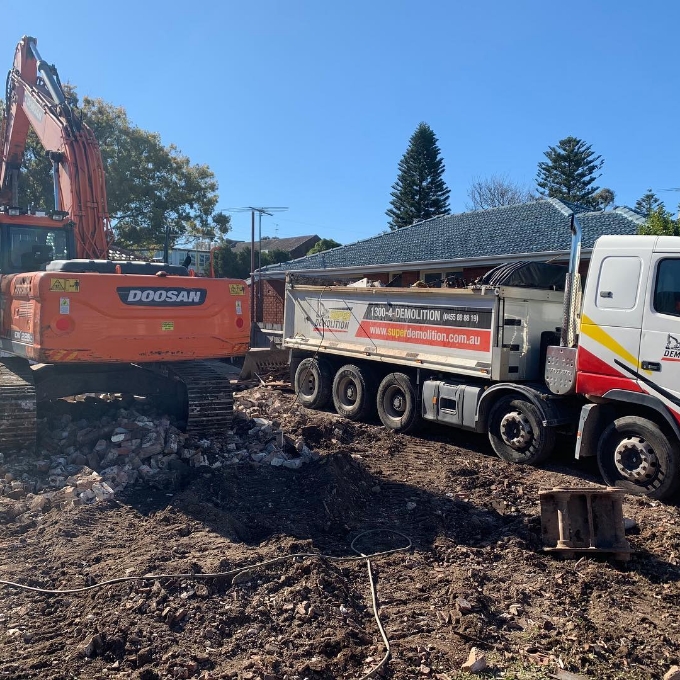
A full knockdown takes the house, the garage, sheds, carports, fencing, driveways and the slab, while a partial demolition takes a wing, a level or the internals and leaves the rest propped and standing. Pools, sheds and garages come out on their own where that is all you want gone.
Shopfronts, offices and industrial units are the same licences in a different order, stripped so the tenancies around you keep trading, which is our commercial demolition service.
Bonded sheeting turns up in eaves, wall linings and old sheds in houses of a certain age. It leaves site under our own licence rather than in the general waste, and our asbestos removal service sets out how it is carted and cleared.
None of the following comes back to you:
What is left for you is a signature and a date.

Nobody can put a number on this from the street. What moves it is out of sight: what the house is framed and clad in, whether bonded sheeting is in it, how deep the slab and footings run, and whether a pool or a tank comes out with it.
The site assessment is free and commits you to nothing. The written quote itemises the works, the approvals and the disposal, and that is the figure you pay, with no hidden fees and no variations later. If you hold a written quote from another contractor, we will beat it.
Whatever your plans say, so tell us what the builder wants gone. A knockdown normally takes the driveway and paths with it, because the new footings and services run straight through them. Fencing on a shared boundary can be left, provided we can still get plant onto the block.
What is published about a suburb is not what sits on its register. The most recent local story attached to the Ermington name is from 2014, when the Putt Putt mini golf course made way for an apartment development, and it tells you nothing about your block. Council keeps its own list, and a certificate signed by a private certifier may never surface where you thought to look. We check your address against the register and the mapping instead.
Largely, yes. Directory pages headed with a suburb name list service areas rather than premises, and one headed for Ermington and postcode 2115 carried firms based in Greenacre and Baulkham Hills. A postcode on a listing proves nothing, and neither does a suburb name inside a company name. Ask for the demolition licence and the asbestos removal licence, and ask who is coming out to look at the block.
Get a Response With in 24 Hours.
Ermington asks fewer questions of a demolition contractor than most suburbs around it: the consent authority is the same at every address. What is left is the block: what is in the walls, what is under the slab, and how much of it your plans want gone. Send us the address and we will walk it, name the route it qualifies for and put the price in writing. Call 0455 888 819 or email info@superdemolition.com.au.


 info@superdemolition.com.au